Service Design • UX Design • Systems Thinking • Ethnographic Research
Eleva: Elevating Humanity
Project Details
| Role | Researcher & Service Designer UX Flows, Ethnographic research, Touchpoint Prototyping, Testing |
| Duration | 4 months (Oct-Jan 24/25) |
| Institution | Politecnico di Milano |
Eleva is a product service solution, addressing displacement and the honoring of human dignity of unhoused peoples living in Milan.
Eleva is a sleek, beautiful lightweight stool designed to be foldable and portable. It layers impact both as a symbolic tool restoring dignity and as a functional information point for the public that conforms and challenges neoliberal conceptions of labor.
Overview
Eleva is a product-service system designed to restore the human dignity and visibility of the unhoused population in Milan. The project centers on a foldable, portable, and lightweight stool that elevates unhoused individuals from the ground to eye-level, functioning on two planes, Eleva both physically and symbolically promotes common human dignity through the projects core values: height, reciprocity, and beauty.
Beyond a physical object, Eleva empowers the user to act as an info point to encourage natural community connections. By displaying an “ask me” sign, the primary user leverages their expert knowledge of the city’s geography and resources to assist residents and tourists. Partnering with The Italian Red Cross, the service manages stool distribution and volunteer support. The result is a dual-purpose solution: it provides a comfortable, beautiful alternative to hostile architecture while reintegrating unhoused individuals into the social fabric as active participants.
Design Challenge
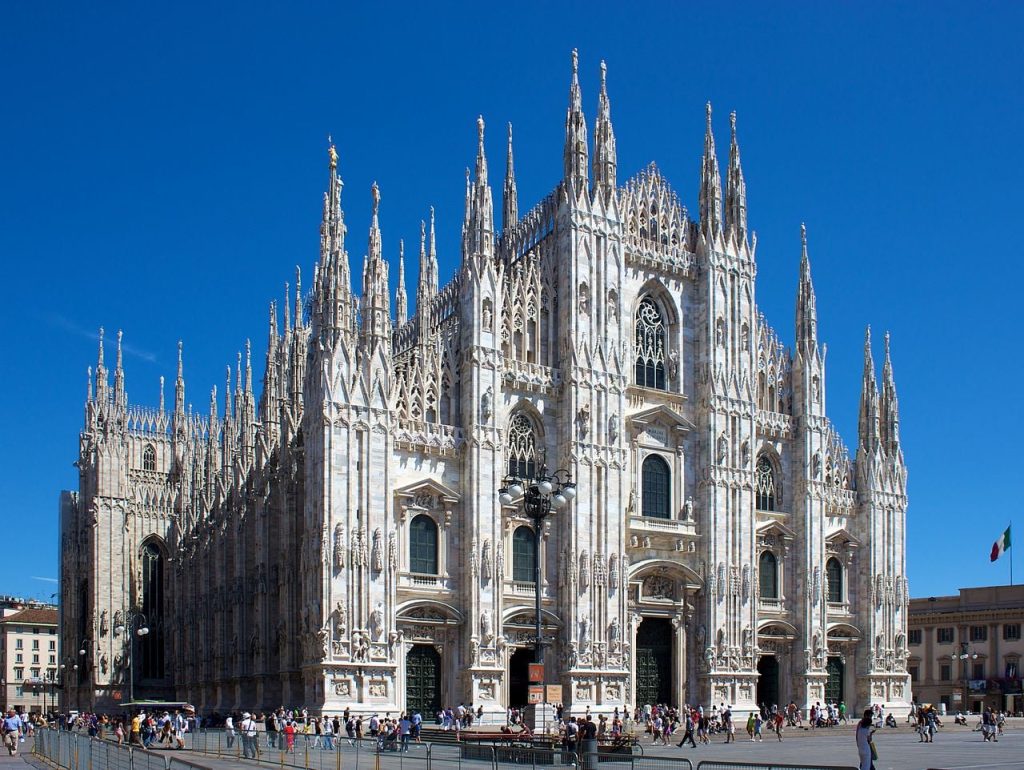
As of 2021, 96.197 people were unhoused in Italy. Experts consider this statistic, which is the most recent available, to be a gross underestimate of the actual number of individuals living without homes in Italy. These statistical inaccuracies in both count and in recency point to a broader issue, the same broader issue that we took on as our design brief: to design a product service system that promotes the visibility of those experiencing homelessness in Milan through drawing attention to shared human dignity.
We defined three project constraints:
- The solution must facilitate social connection
- The solution must and be strongly rooted in the Milan social and physical infrastructure
- The solution must promote visibility without compromising dignity
Process
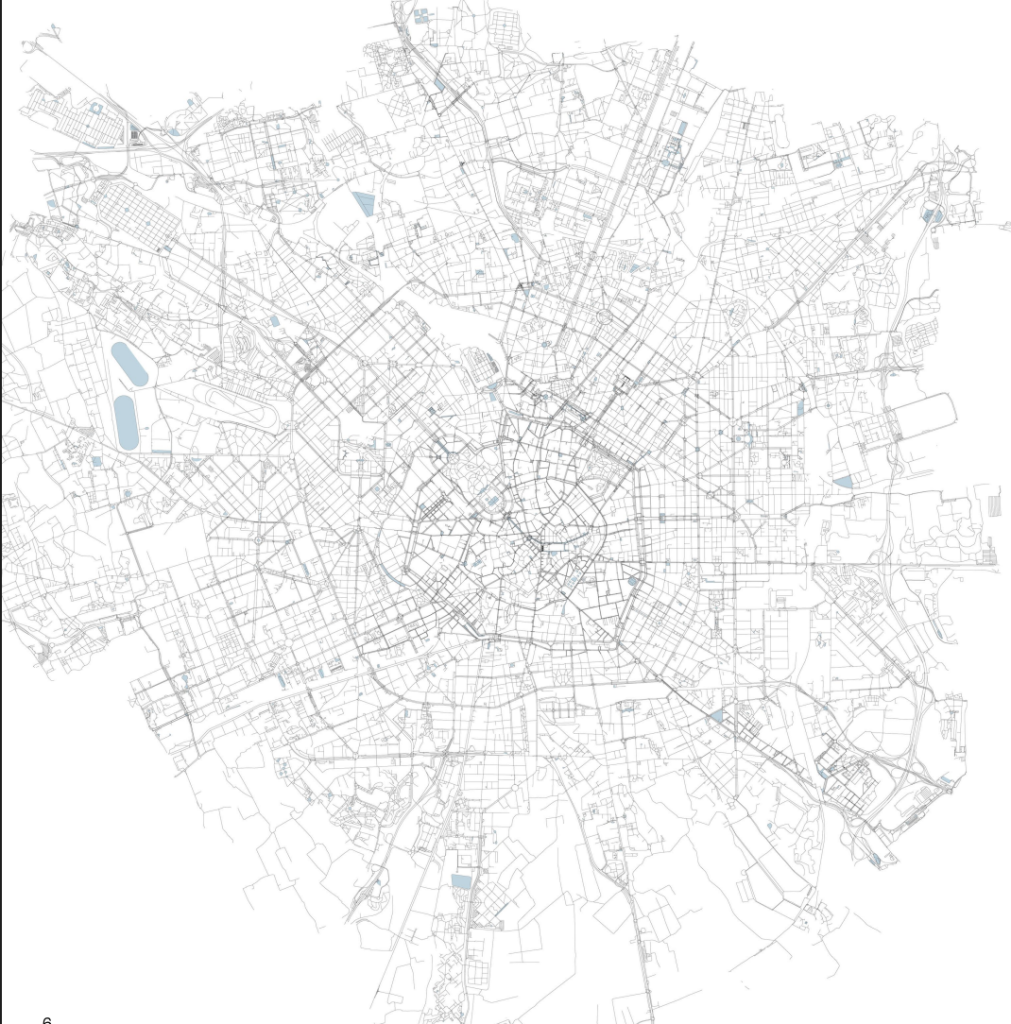
The research process adopted a community-driven approach, focusing on Milan’s “zone” style of living where both housed and unhoused residents inhabit and perform daily activities within specific residential areas. To navigate ethical constraints and avoid extractive practices, the team opted against direct interviews with vulnerable groups, instead utilizing content analysis of secondary sources.
Key Research Pillars:
- Content Analysis: The team studied The Book of Homelessness and documentary interviews to identify unmet user needs including: stability, personal agency, and social connection.
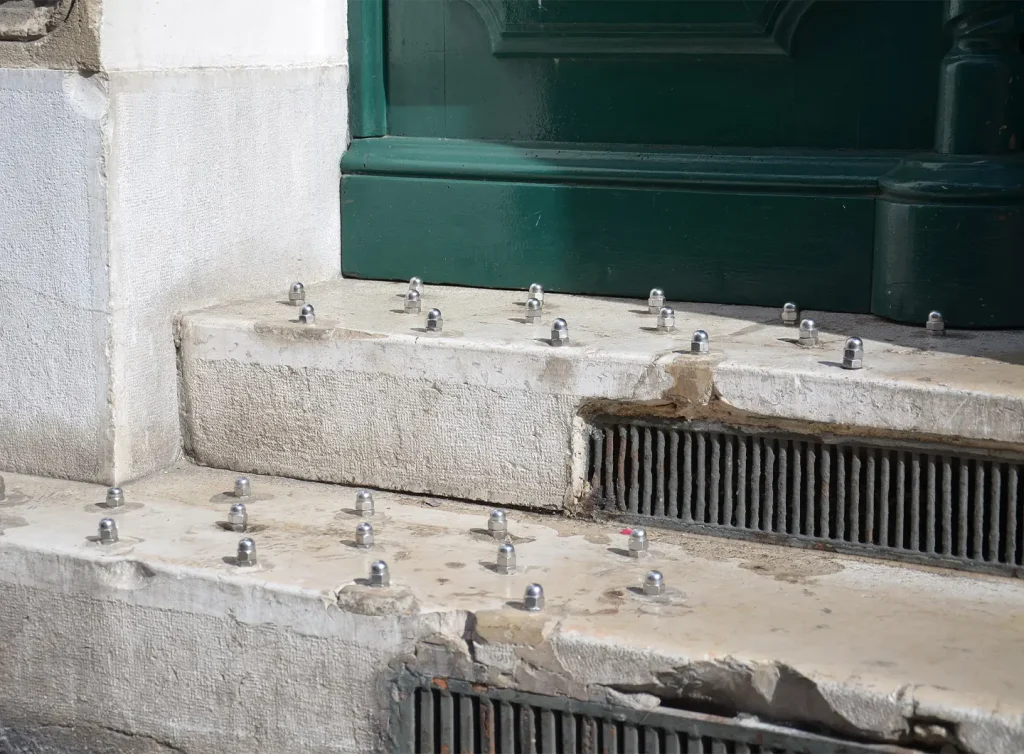
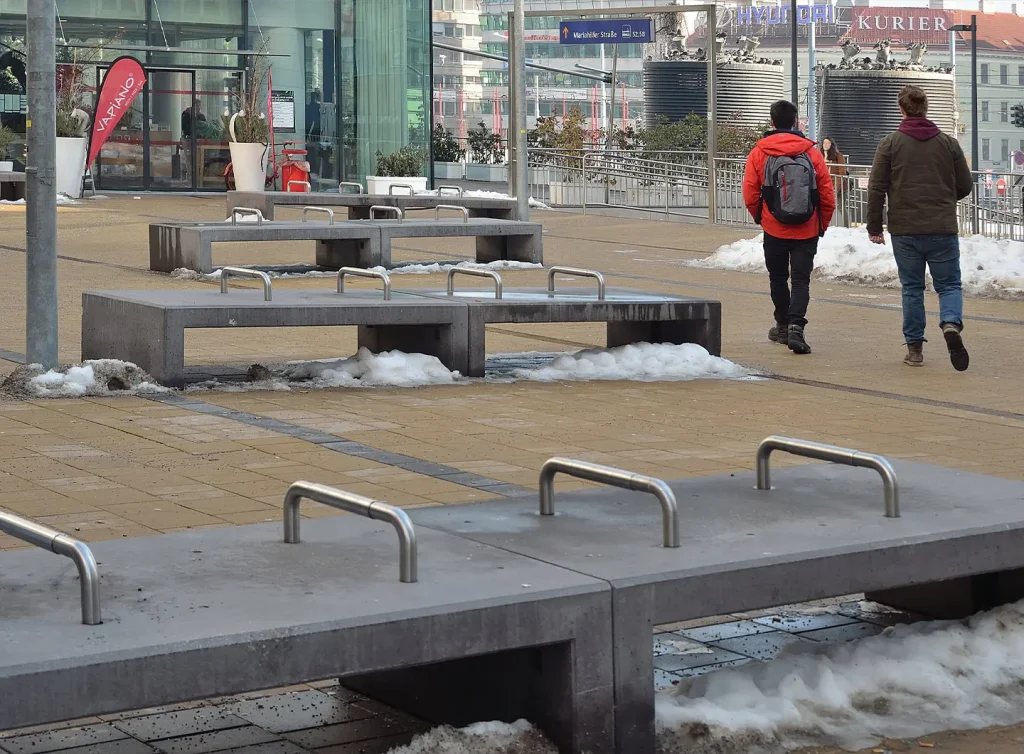
- City Observations: Presence of hostile architecture throughout Milan as well as policing tactics create an environment in which the unhoused are transient and their situation is unstable. We understood the importance of creating a tool that is portable and long-lasting.
- Stakeholder Insights: Qualitative research with Milanese residents indicated that while many desire to help, a lack of structure and fear act as barriers to engagement.
Strategic Pivot:
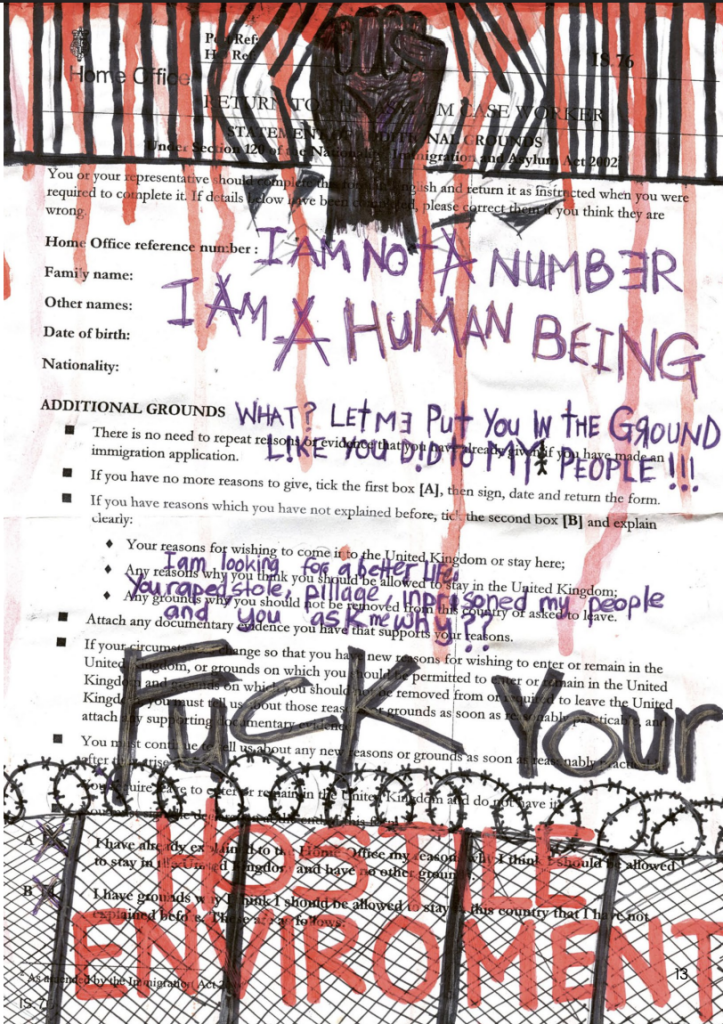
The most significant insight came from a synthesis of both neoliberal sociological theory from Giroux’s Biopolitics of Disposability and qualitative research findings. This synthesis allowed us to reimagine the positioning of the user from a place of empowerment and not need. From this perspective, we understood that our primary user, unhoused individuals, are experts of the city-scape, possessing vast knowledge of geography and resources. This shifted the project from a passive seating solution to a productive service system that works to reimagine narratives of disposability and productivity in neoliberal city-scapes.
Prototyping
The Product
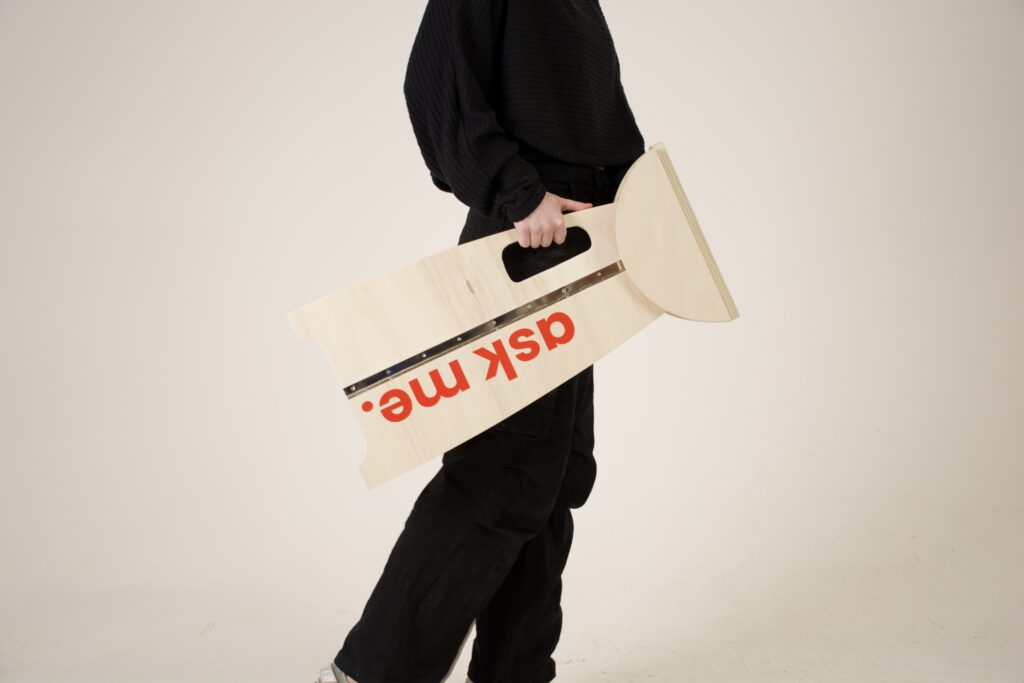
To bring the Eleva concept to life, we moved from theoretical design to functional physical modeling. We utilized the Allestimenti Laboratory at Politecnico di Milano to construct a scale model using light wood, which mimicked the intended sand tone of the final product.
The prototyping process allowed us to test and refine:
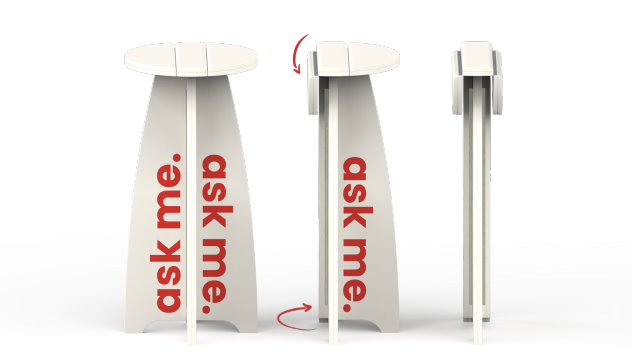
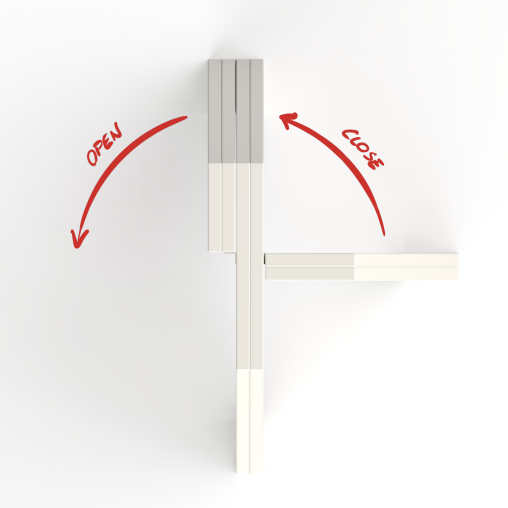
- Folding Mechanics: We successfully replicated the piano-hinge movements, ensuring the two seat “wings” and the movable legs could fold into a compact form.
- Portability: We integrated a handle into the main body and confirmed that a closed thickness of approximately 110mm was suitable for transport.
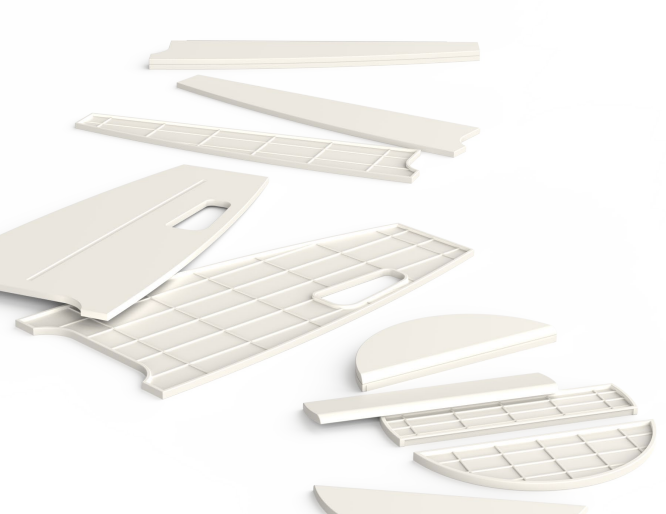
- Component Assembly: The prototype helped visualize the snap-fit mechanism intended for the final Polypropylene (PP) shells. While the wooden prototype was heavier than the final plastic version, it validated the stool’s stability and its ability to function as a support surface even when closed.
The challenge: beauty and aesthetic. Eleva was built for beauty; designing both a functional, durable, and portable stool while creating a beautiful and high-quality product became the largest challenge in this stage. As the primary research and service designer, I navigated the iteration, review, and testing of multiple prototypes in order produce a high quality functional product within the time constraints. The ultimate design of Eleva was, in focus groups, reviewed as eliciting the greatest sense of both luxury and durability.
Technical Prototyping
MVP
The Service
In order to prototype Eleva as a service offering, we completed simulated interactions in the PSS with key project stakeholders including: service design experts, members of Red Cross Italia, and experts in public housing and social welfare in Milan.
We used desk-top walkthroughs and PSS role play to understand points of strength and weakness in the project. This stage of prototyping informed an important project pivot. Through prototyping, we understood the importance of measuarble impact. With this in mind, we designed a tracking mechanism for each Eleva stool (considering participant consent) that measures connections made
After the prototyping, we found participants were most interested in contributing to counter-narratives of hostile architecture. We received feedback that our service lacked a durable way to imagine long-term dignity restoration in public spaces in Milan beyond micro-interactions. Accordingly, we, in alignment with Red Cross service offerings, integrated the ask-me
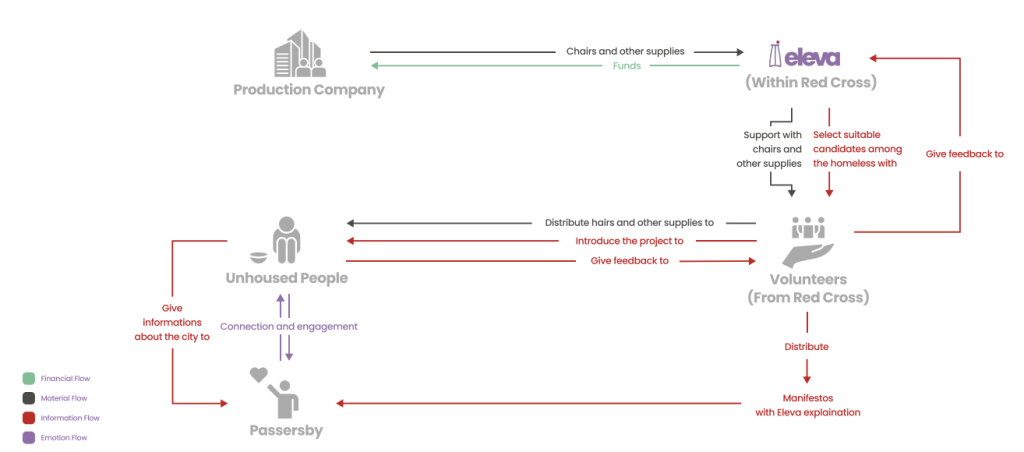
System Map
Touchpoints
Final Outcome
The final Eleva service is a comprehensive system that, as imagined, would be managed by The Italian Red Cross.
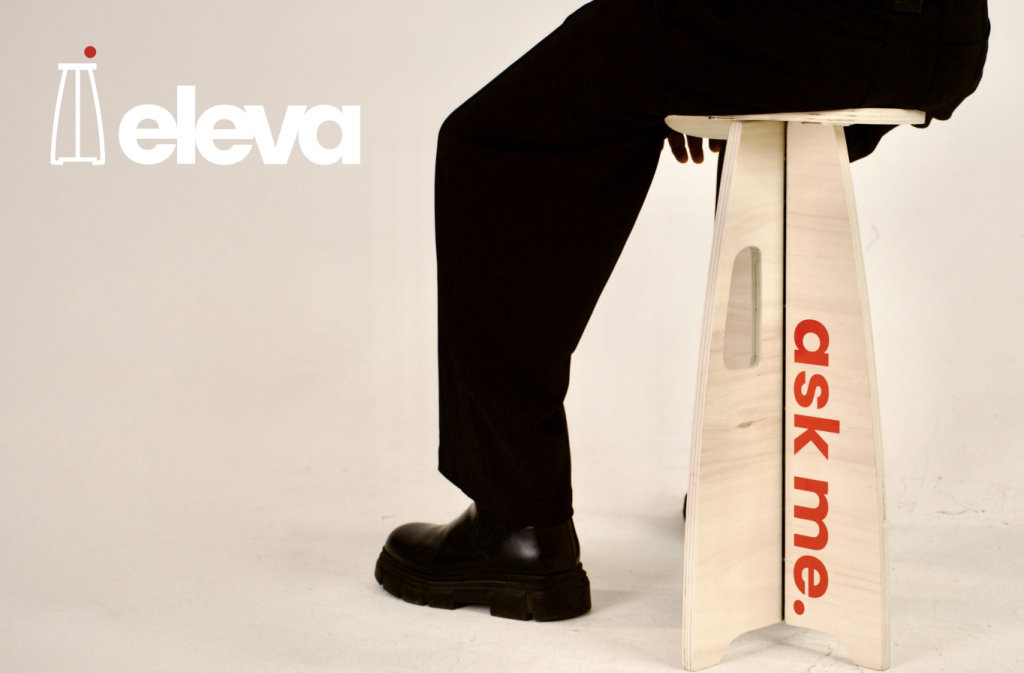
- The Product: An injection-molded Polypropylene stool featuring internal ribs for stiffness and magnets to keep it securely closed during transport. It is available in various colors—sand, purple, green, and grey—to respect the user’s autonomy and personal choice.
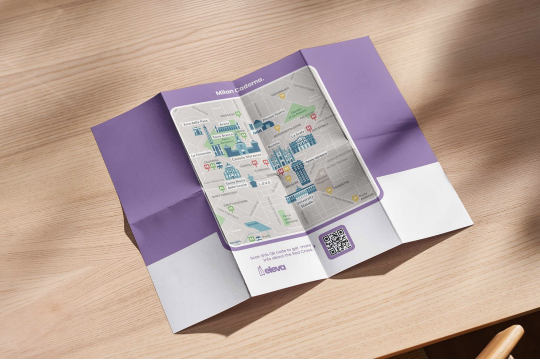
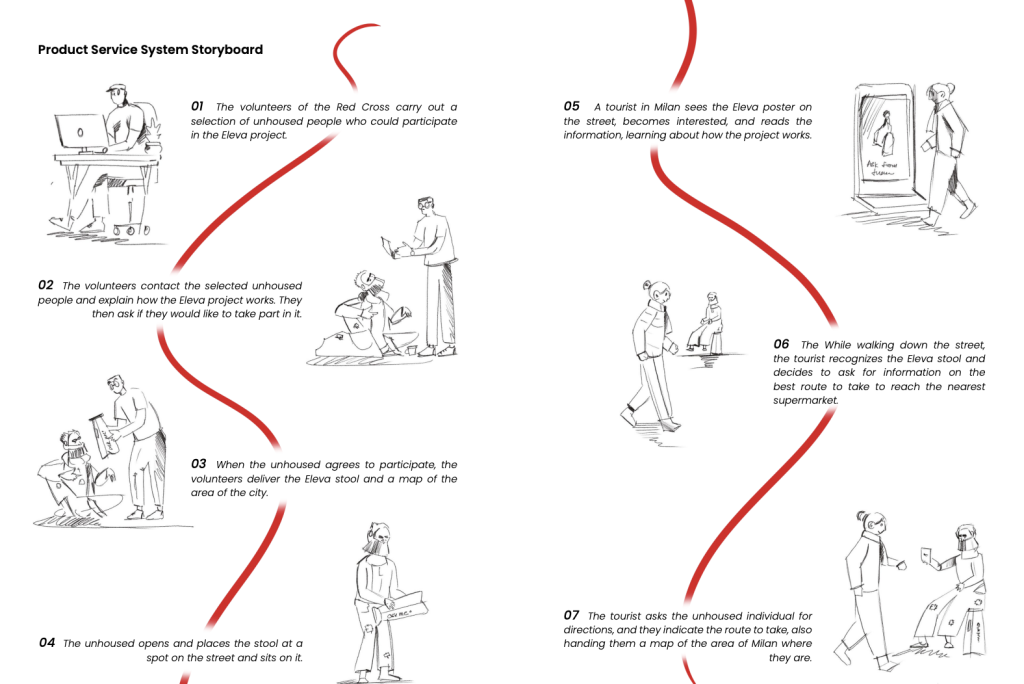
- The Service: Volunteers select participants based on voluntary consent and capability. Participants are provided with the stool and city maps to facilitate their role as neighborhood experts.
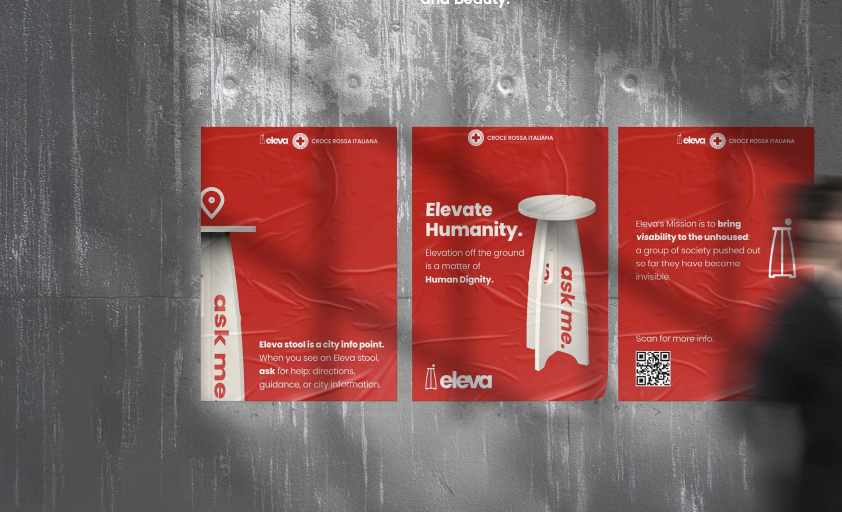
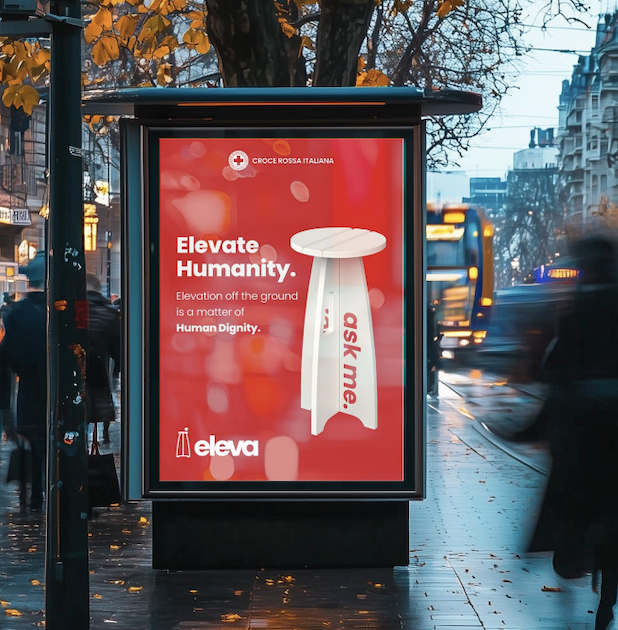
- Awareness: Striking digital banners and posters are placed in metro stations and bus stops to educate the public on the project’s mission, reducing the “barrier of fear” for passersby.
User Journey
Project Core:
- Dignity through height: eye to eye interactions encourage dignity and connection. Eleva aspires not only to visibility but to elevation for the unhoused, both physically and metaphorically. With this in mind our first design constraint is dignity through height
- Beauty as a matter of human dignity: Eleva’s beauty rewrites narratives surrounding the unhoused that often associates them with being ‘unclean’. Eleva is a counter visual to the hostile architecture that has been embraced in Milan in order to rewrite narratives of place and belonging within Milan’s city structure.
- Portability to support autonomousness: after understanding the context of displacement and the user desire for ownership and resource control we found portability to be an essential feature of Eleva.
Reflection
Working on Eleva highlighted the profound impact design aesthetics can have on social issues. We learned that beauty is not a luxury but a matter of human dignity that can disrupt dehumanizing narratives. By designing a stool that is enviable, we force a re-evaluation of the person using it.
The project also underscored the importance of reciprocity in service design. Instead of a one-way donation, Eleva creates a mutual exchange between the local community, the unhoused, and the Red Cross. Looking forward, the proposed Art Exhibit expansion offers a path for further humanization, allowing the unhoused to reclaim their voice through creative expression. Eleva demonstrates the importance of intersecting rich sociological theory with service design solutions to create transformational impact for organizations like the Red Cross.
User Empathy | Milan | Dignity | Urban Design